
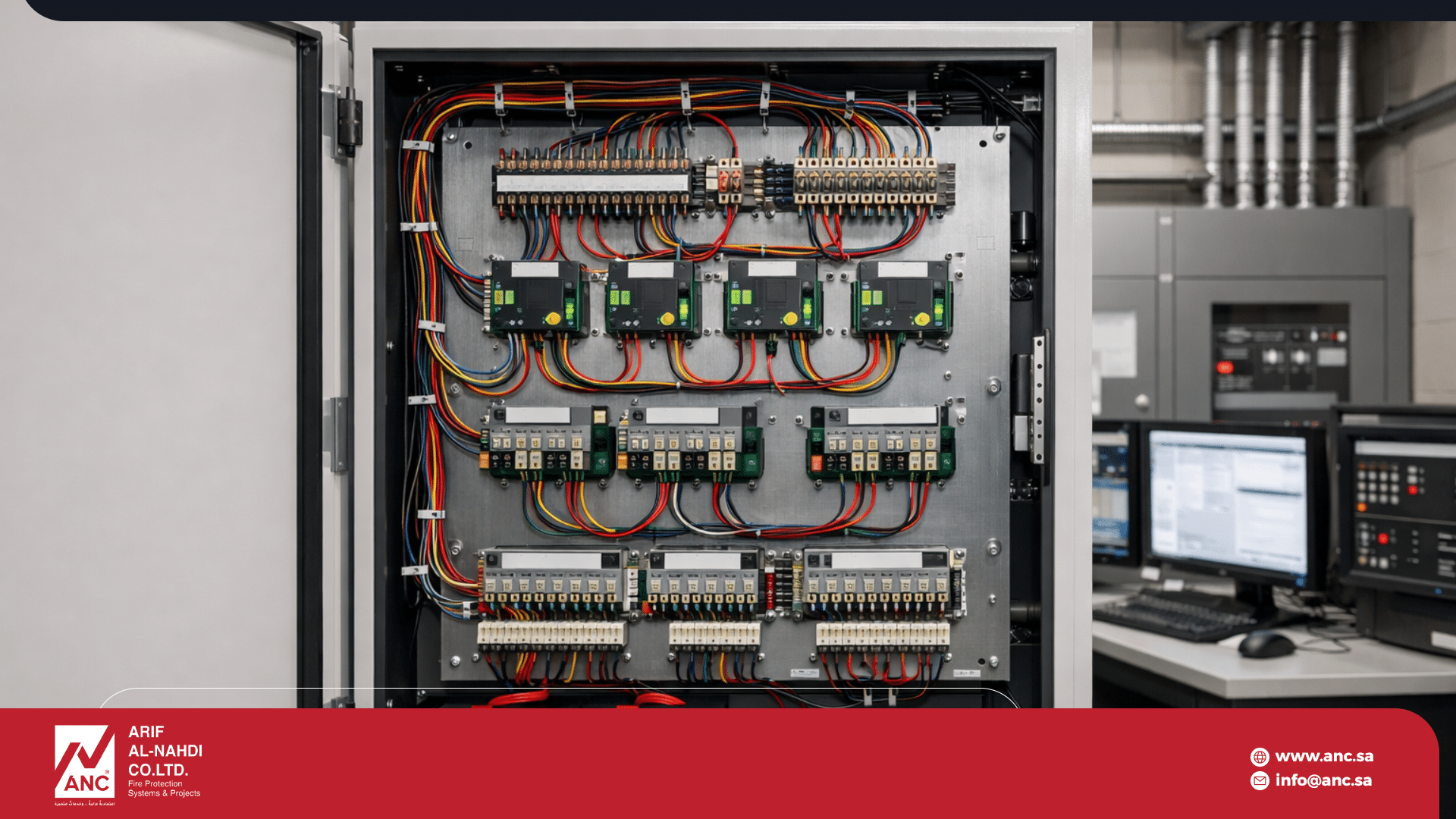
An addressable fire alarm system is often the first option people hear about when a project in Saudi Arabia involves multiple floors, mixed occupancies, or any requirement for clearer fault location and easier future expansion.
But many online explanations jump straight to fixed devices per loop or maximum cable length numbers—then you discover later (during submittals or commissioning) that the real answer depends on the panel brand/protocol, device load, cable design, topology rules, and voltage-drop limits. That’s where delays, rework, and failed acceptance tests usually start.
This guide is for facility/safety teams, contractors, consultants, and procurement who need a simple, technically correct path: what addressable means, SLC loops basics, what programming includes, and how to verify loop capacity and cable limits using manufacturer datasheets and loop calculators.
What is an Addressable Fire Alarm System?
An addressable fire alarm system is a fire detection and signaling system where each device (smoke detector, heat detector, manual call point, monitor/control module, etc.) has a unique address/ID.
When the panel receives an alarm, trouble, or supervisory signal, it can identify exactly which device (and often the configured location text) is involved—rather than only identifying a broader zone.
That single concept—device-level identification—is the core difference that drives the most important benefits for facility teams:
- Faster fault finding: You spend less time searching the building when a device reports a fault.
- Clearer event reporting: Alarm/trouble history is more actionable for operations and maintenance.
- Better scalability: Many projects find it easier to expand device counts and add functions as the site grows—as long as the panel and loop design support it.
What it is not: a guarantee of better safety on its own. addressable fire detection system performance and reliability still depend on approved design, correct installation, correct configuration, and ongoing inspection/testing.
If you’re planning a new build or retrofit, request an ANC technical consultation to review your scope, authority requirements, and the right documentation set before procurement.
Addressable vs Conventional Fire Alarm System: Key Differences (When to Choose Each)
People often ask Is addressable always better? The safer answer is: it depends on building complexity, required functions, and lifecycle expectations.
Conventional systems can be perfectly appropriate in simple layouts with straightforward zoning and minimal integration needs.
Here’s a decision-friendly comparison designed for Saudi facilities, without relying on misleading fixed capacities.
Addressable vs Conventional Fire Alarm Systems for Saudi Facilities
Factor | Addressable | Conventional |
Concept | Device-level identification (unique address per device) | Zone-level identification (devices grouped by zone) |
Wiring approach | Commonly uses SLC loop(s) for devices + separate NAC circuits (varies by design) | Zone circuits for detectors/call points + NAC circuits |
Event location clarity | Higher: identifies exact device address (configured text) | Lower: identifies zone only |
Expandability | Often easier to expand logically, but must validate loop/panel capacity | Expansion can require additional zone cards/cabling changes |
Integration (BMS, smoke control, elevators, dampers) | Typically more flexible via modules and cause/effect mapping | Possible, but may be more limited depending on panel features |
Troubleshooting effort | Usually faster—device-specific troubles | Often slower—zone-level troubleshooting |
Maintenance impact | Better visibility for recurring device issues | Simpler conceptually, but less granular diagnostics |
Best-fit use cases | Multi-floor buildings, hospitals, hotels, data rooms, mixed occupancies, integration-heavy sites | Small/simple sites with minimal integration and clear zone layout |
Notes & constraints | Capacities/loop limits vary by manufacturer; requires disciplined documentation | Can be cost-effective and simpler to maintain in very small scopes |
When addressable fire alarm systems are usually worth considering?
- You expect future expansion or tenant changes.
- You need integration (e.g., smoke control interfaces, dampers, elevator recall, BMS monitoring).
- You value precise troubleshooting because downtime or false alarms are costly.
When conventional Fire Alarm System may be enough?
- Small buildings with simple zoning and limited functions.
- You want minimal configuration complexity and straightforward maintenance—and it meets the project requirements.
Ask ANC for a requirements review so the selection aligns with your approved drawings/specs and authority/owner expectations.
How the SLC Loop Works (Class A/B, Isolators)?
In many addressable fire alarm systems, devices communicate with the fire alarm control panel over an SLC (Signaling Line Circuit)—often called the loop.
Think of the SLC as the panel’s communication highway to addressable devices and modules.
What the SLC does?
- Allows the panel to poll devices and receive status.
- Allows devices/modules to report alarm, trouble, or supervisory conditions.
- Supports a structured device list with addresses and descriptive location text.
Class B vs Class A
- Class B: Typically a single pathway. If the pathway is interrupted (open), devices beyond the break may be affected (how the panel reports and isolates depends on manufacturer/design).
- Class A: Typically a return path is provided, so a single open on the pathway doesn’t necessarily isolate all devices beyond the break. The practical value is improved survivability—again, how this is achieved and reported is manufacturer/design dependent.
What isolators do?
Short circuits are a common concern in any field wiring. Isolators (whether built-in, in devices, or as separate modules) are used to limit the impact of a short circuit so that the entire loop isn’t taken down by one fault.
The exact behavior and placement strategy vary by manufacturer and by the approved design.
Internal link suggestion: Link to an ANC addressable module example page as a practical integration concept (e.g., interface module for a damper or monitored input), without listing model-specific capabilities in this article.
Note: Loop class selection and isolation strategy should follow the approved drawings and project specifications—this is not a one size fits all choice.
Also read: Standard Fire Pumps vs. UL/FM-Approved Fire Pumps: Which One Is Best for Your Needs?
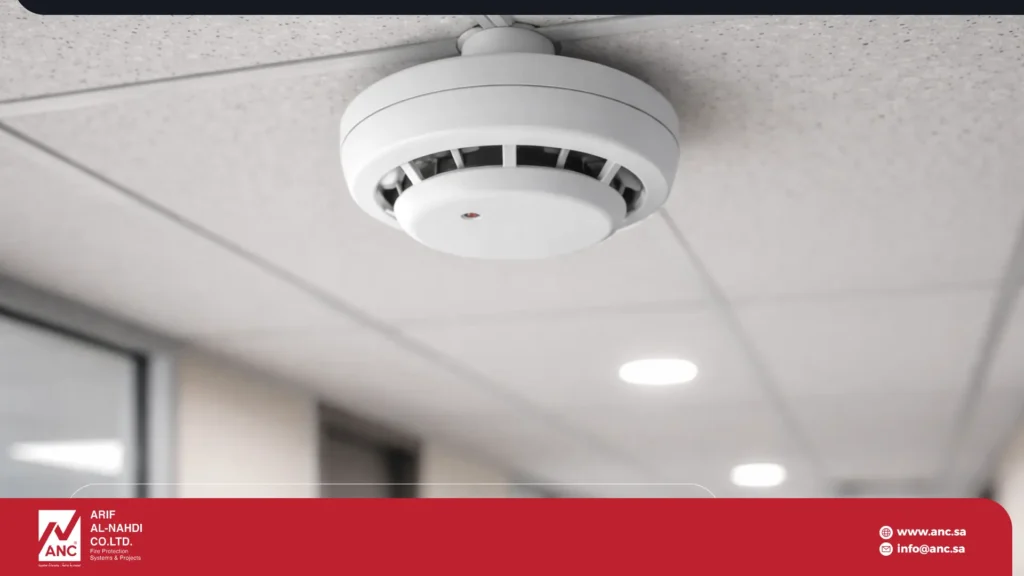
Addressable Fire Alarm System Programming: What Gets Configured?
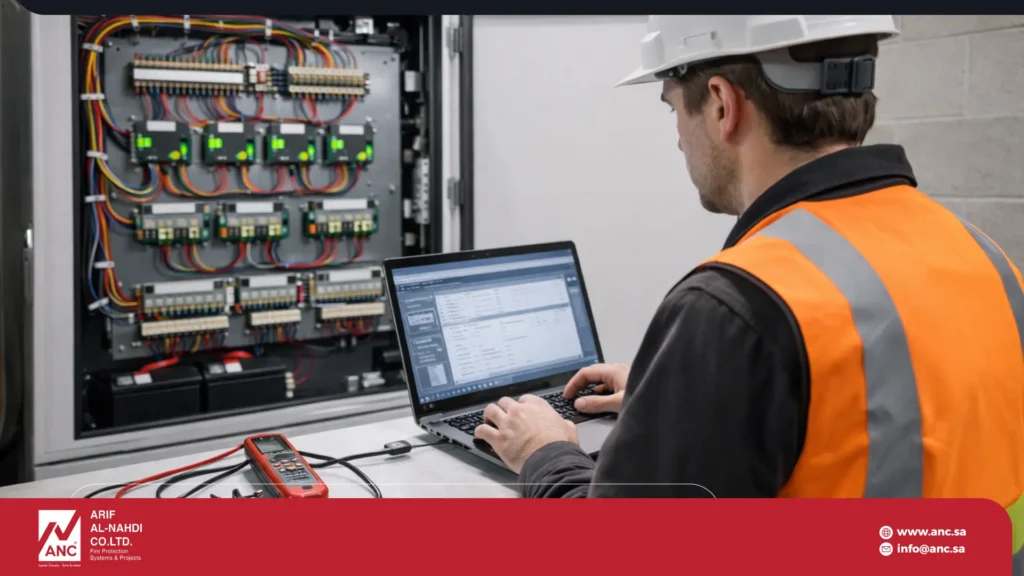
Programming is where addressable systems either become a facility’s best friend—or a long-term headache. It’s not just setting addresses. It’s configuring how the system interprets and responds to events.
What typically gets configured?
1- Device addressing & labeling
- Assigning device IDs (addressing method depends on vendor)
- Location text and device description standards (consistent naming matters)
2- Logical zoning
- Grouping devices into zones/areas for response logic and reporting
(Even addressable systems still use zones conceptually for operations.)
3- Cause & Effect (C&E)
- If this happens, the system does that.
Example categories: alarm outputs, signaling behavior, interface actions (where permitted), supervisory behaviors.
4- Integration mapping
- Interfaces to other systems (e.g., smoke control sequences, elevator recall signals, monitored inputs/outputs) based on project requirements.
5- Event priorities and reporting
- Alarm vs supervisory vs trouble behavior
- Notification, panel display priorities, logs, and reporting formats
Deliverables you should expect at handover
Ask for a complete documentation pack that allows you to operate, maintain, and audit the system:
- Device address list (with locations)
- Cause & Effect matrix
- As-built drawings and device schedule
- Testing/commissioning records (acceptance test documentation as required)
- Panel configuration backup / programming file handover policy (as permitted)
- O&M manuals and recommended maintenance schedule framework
- Training sign-off for facility staff (where part of scope)
Mini handover checklist
- Can your team identify device locations from the panel text without guesswork?
- Do you have the latest as-builts and an address list that matches reality?
- Is the Cause & Effect matrix signed and aligned with project specs?
- Are test records filed and retrievable for authority/insurance/owner audits?
- Do you have a clear maintenance plan and issue-tracking process?
If your project includes programming, commissioning support, or you’re inheriting an existing system with incomplete documentation, submit an ANC Service Request for technical review and restoration of handover documentation.
Read more: Causes of Sudden Water Pressure Drop in Fire Networks and How to Address Them
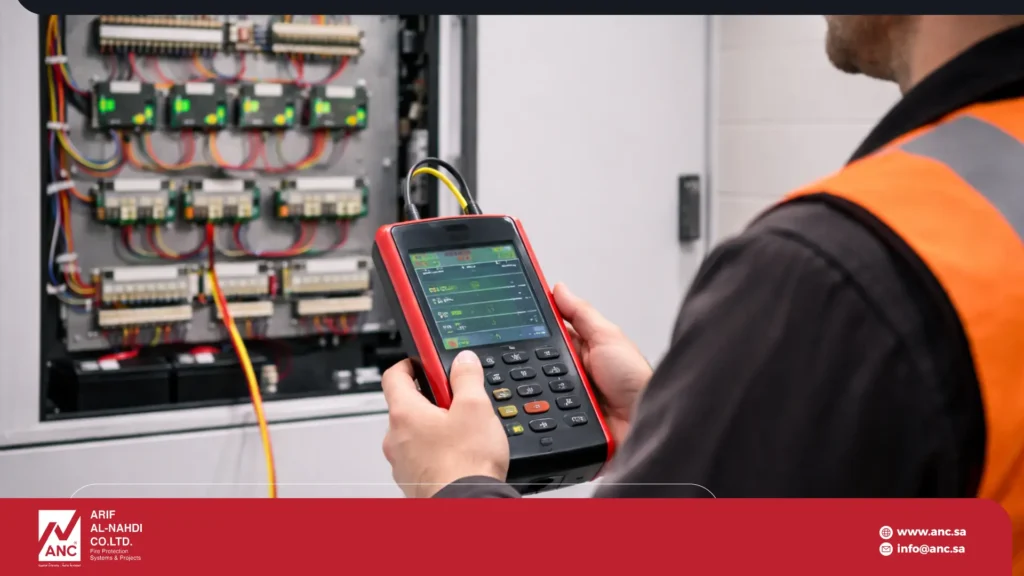
Devices per Loop & Max Cable Length
This is the most searched—and most commonly mishandled—topic. Many online pages publish a single max devices per loop or max cable length. That can be misleading.
Why there is no universal fixed number?
Loop capacity and maximum length depend on:
- Panel/manufacturer protocol & design rules
- Device load characteristics (some devices/modules draw more)
- Cable type/gauge and installation conditions
- Topology decisions (branching rules vary by manufacturer)
- Voltage drop and communication integrity limits
- Isolator strategy and field conditions
So the correct answer is: validate your specific design using manufacturer documentation and engineered loop calculations.
A safe, practical verification method
Use this verification path before procurement and again before commissioning:
- Identify the intended panel family and the specific addressable device series intended for the project.
- Collect manufacturer datasheets for:
- Fire alarm control panel (loop rules, limits, compatible devices)
- Addressable devices/modules (current draw, wiring rules)
- Use the manufacturer’s loop calculator/design tool (where provided) or approved engineering method.
- Review the design against:
- Approved drawings/specifications
- Saudi authority/owner/consultant requirements
- Pathway class requirements (Class A/B) and isolator strategy
- Document the outcome as part of submittals:
- Calculations summary
- Device schedule and loop allocation plan
Examples of what increases loop load (conceptual)
- Certain modules that power field devices or interface to actuated equipment (varies by type)
- Sounder bases or specialized devices (depends on product line)
- Long runs with multiple devices and challenging routing constraints
Request an ANC technical consultation to validate your loop design approach and submittal completeness—especially if a consultant/authority requires documented calculations.
Is Addressable Fire Alarm Suitable for Small Buildings?
Yes, an addressable fire alarm system can be suitable for small buildings—but the decision should be made based on operational needs, future changes, and required functions, not marketing.
When addressable makes sense even in smaller sites?
- You expect tenant changes or floorplan changes.
- You want faster troubleshooting (limited staff, faster incident response).
- You have integration needs (even one or two critical interfaces can justify addressable architecture).
- You need a more structured event history and diagnostics for compliance and audits.
When conventional may be the practical choice?
- Simple layout and stable occupancy.
- Minimal integration scope.
- Straightforward zoning is sufficient and meets project requirements.
Three small building scenarios (realistic, non-hyped)
- Small clinic: Addressable may help if you need clearer device-level identification and scheduled maintenance with minimal disruption; integration needs vary.
- Small office: Conventional can be sufficient if zoning is straightforward and expansion is unlikely; addressable becomes attractive if tenant churn is high.
- Small warehouse: Conventional may work for basic detection/notification; addressable becomes more attractive if you have multiple areas, future partitions, or want granular fault location.
Also check: Electric vs. Diesel Fire Pumps: Which Is Better?
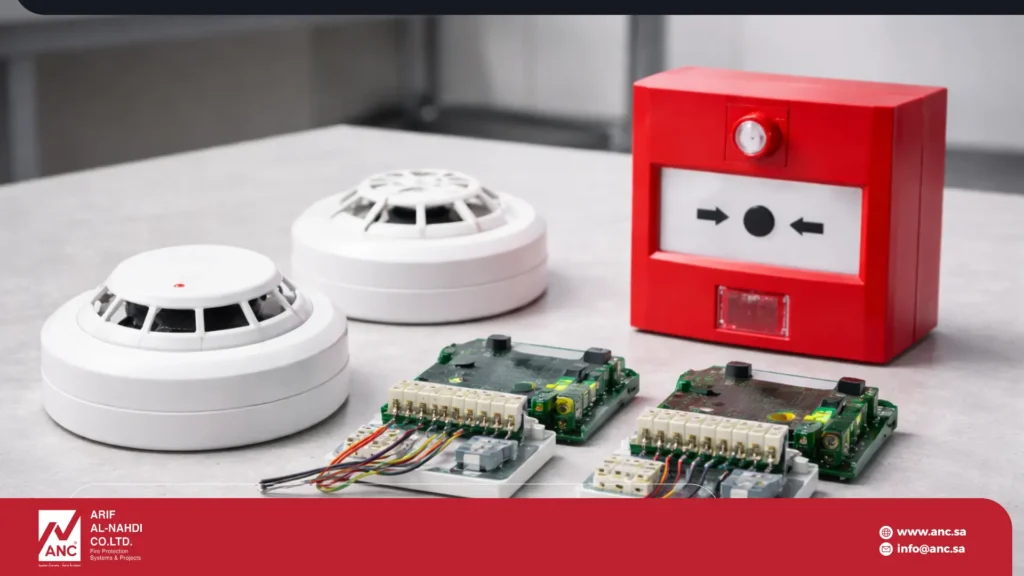
Standards & Requirements for Addressable Fire Alarm System in Saudi Arabia
In Saudi Arabia, selection and acceptance are shaped by project documentation and local requirements, not just product capabilities.
Two commonly referenced sources (depending on project specs) include:
- NFPA 72 (National Fire Alarm and Signaling Code) as a widely used reference for system performance, inspection/testing concepts, and signaling practices.
- SBC 801 (Saudi Building Code—fire protection provisions) as part of the local regulatory framework for fire protection.
What matters practically:
- Your project will typically require approved drawings/specifications, and the authority/owner/consultant may define:
- system architecture expectations (addressable vs conventional in certain occupancies)
- documentation requirements (submittals, calculations, test reports)
- acceptance testing expectations and reporting format
Addressable Fire System Delivery, Testing & Maintenance: What a Successful Project Looks Like?
A successful project is not panel installed and powered. It’s a controlled lifecycle that ensures the system remains reliable after handover.
Lifecycle view
- Requirements & scope definition
- Design and approved drawings
- Submittals (devices, compliance documents, calculations, C&E)
- Supply and installation
- Programming & configuration
- Testing/commissioning and documentation
- Handover and training
- Ongoing inspection/testing/maintenance
Pre-purchase & pre-handover checklist
Before installation begins
- Approved drawings/specifications are final (no design-in-field surprises)
- Device schedule and locations are defined
- Pathway class strategy and isolator approach are documented (as required)
- Integration list is confirmed (what needs to interface, what doesn’t)
Before handover
- Alarm, trouble, and supervisory conditions are tested and recorded per project requirements
- Integration points are verified and documented (where in scope)
- As-builts, address list, C&E matrix, and test records are complete
- Facility team receives an operational briefing and knows how to report issues
Operations (ongoing)
- Periodic inspection/testing plan is documented and assigned
- Faults are tracked (date, device, resolution, recurrence)
- Documentation remains current after any change
Common failure risks
- Wrong device selection for the environment (leading to nuisance alarms or frequent faults)
- Incomplete cause/effect documentation (confusion during incidents)
- Missing as-builts and address list mismatch (maintenance becomes guesswork)
- One-time commissioning mindset with no periodic testing discipline
If you already operate a fire alarm addressable system, submit an ANC service/maintenance request to review documentation completeness, restore missing records (where possible), and set a sustainable maintenance workflow.
Read also: Difference Between ABC Powder and CO₂ Fire Extinguishers
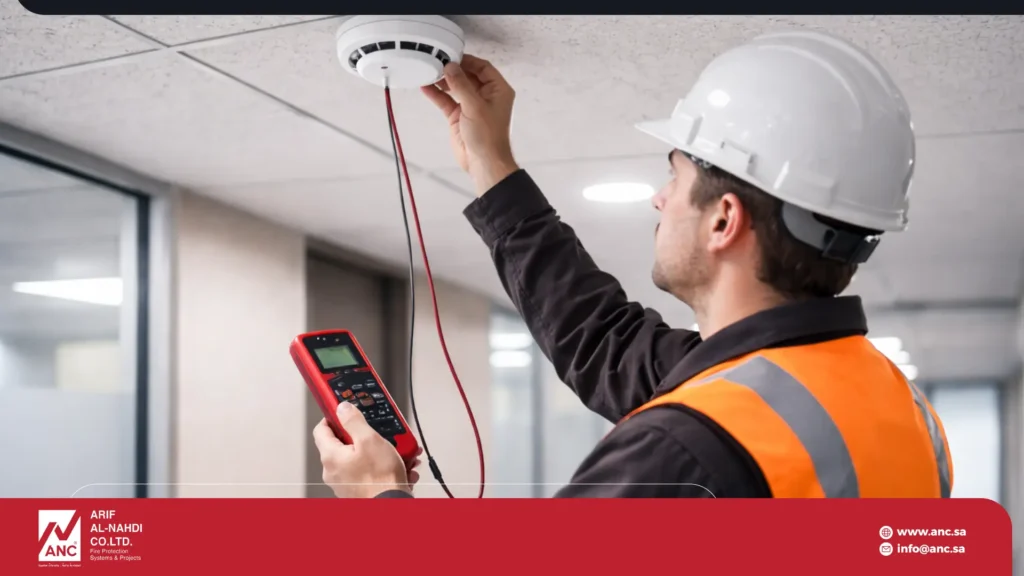
ANC Services for Fire Alarm Addressable System in Saudi Arabia (Supply, Implementation, and Maintenance)
ANC (Arif Al Nahdi Co. Ltd.) supports Saudi projects with a practical, end-to-end approach to fire alarm systems—starting from scope clarity and submittal readiness, through system supply and implementation support, and continuing with planned maintenance and responsive service.
The goal is not just to deliver panels and devices, but to help stakeholders (owners, consultants, contractors, and facility teams) reduce common project risks: unclear device schedules, incomplete documentation, integration gaps, and handover packages that don’t match the as-built reality.
With ANC, the focus stays on decision-quality engineering inputs, documented deliverables, and maintainability, so approvals, commissioning, and long-term operation are smoother and more predictable.
Supplying Fire Alarm Systems (Panels, Devices, and System Packages)
- Help align the supply scope with the approved design intent (device types, functions, interfaces) to avoid procurement surprises.
- Support submittal packages with the right datasheets, compatibility references, and schedules (as required by the project).
- Provide supply options that match the project’s delivery model: supply-only or supply coordinated with implementation.
1- Intelligent Addressable Gas Detection and Alarm System – BR.022
2- Maxlogic Intelligent Addressable Smoke Damper Control Module – MM.BRS.YD.001
3- Maxlogic ML-122X Intelligent Addressable Fire Alarm Control Panel – MM.BRS.YD.007
4- Maxlogic Intelligent Addressable Aspirating Smoke Detector – MM.BRS.YD.052
Implementation Support (Coordination and Site Readiness)
- Coordinate with project teams to confirm practical readiness items that affect delivery quality (routes, locations, interface points)—without giving unsafe “how-to install” instructions.
- Support alignment between drawings, device schedules, and site realities to reduce rework and commissioning delays.
- Help stakeholders keep a clean trail of changes so as-builts don’t become a last-minute scramble.
Programming Support (Configuration Expectations, Not Vendor Hype)
- Clarify what “programming” should include for a maintainable system: device addressing approach, zoning logic, cause & effect expectations, and event reporting structure.
- Ensure stakeholders know what to request in handover: address list, cause & effect matrix, backups (where applicable), and configuration records.
- Support integration readiness by mapping required interfaces to the project’s documented requirements.
Commissioning & Handover Readiness (Documentation-First Mindset)
- Help teams prepare the handover package that owners actually need: as-builts, device lists, test records, and O&M documentation.
- Support a “no surprises” approach by checking for typical gaps that delay acceptance: missing labels/locations, inconsistent schedules, incomplete records.
- Promote clean ownership handover with clear responsibilities and traceable documentation.
Maintenance & Service (Preventive Plans and Fault Resolution)
- Support preventive maintenance planning to keep the system reliable after occupancy (inspection/testing planning depends on project requirements and applicable standards).
- Help facility teams manage recurring issues through structured fault logging and documentation updates.
- Provide service pathways for troubleshooting, documentation recovery, and lifecycle support—especially for inherited systems with incomplete handover.
A Request for Addressable Fire Detection System Quote (RFQ) Data Template
Many searches include addressable fire alarm system pdf. Instead of a generic PDF with questionable numbers, use the following copy/paste RFQ template to get accurate, comparable quotations and reduce scope gaps.
RFQ Data Template for Addressable Fire Alarm Systems
1- Project basics
- Facility type (e.g., office, clinic, warehouse, residential, data room)
- Location (city) and site access constraints (if any)
- New build or retrofit? (include existing system details if retrofit)
2- Building summary (approximate is fine)
- Floors / areas / key zones (basement, roof, mezzanine, etc.)
- Special areas (server rooms, kitchens, high dust, high humidity, etc.)
3- System scope
- Scope required (choose):
- Supply only
- Supply + install
- Supply + install + programming
- Full scope: supply + install + programming + testing/commissioning + maintenance
- Required deliverables (address list, C&E matrix, as-builts, test records, O&M, training)
4- Devices and interfaces
- Estimated device count (if known) or request for survey/estimate
- Required interfaces (select what applies):
- Voice evacuation / paging
- Smoke control / dampers
- Elevators
- BMS monitoring
- Suppression system interfaces (as applicable)
- Other
5- Technical and documentation requirements
- Reference standards/specs required by owner/consultant/authority (e.g., NFPA 72, SBC requirements, project specs)
- Submittal requirements (data sheets, compatibility lists, calculations, test formats)
- Any specific authority/owner constraints on brands or architecture (if stated)
Timeline and constraints
- Target dates (submittals, delivery, commissioning):
- Working hours restrictions / phased handover needs
Request technical consultation (ANC), Validate selection approach, documentation, and verification method before procurement.
Safety & Disclosure (must-read)
This content is for education and procurement decision support. Final system selection, design, installation, testing, and acceptance must follow project-specific requirements, applicable Saudi authority/owner/consultant requirements, and relevant standards (e.g., NFPA references where specified).
No universal guarantees apply without reviewing your project data, approved drawings, and site conditions. Always use qualified professionals for design and implementation.
Conclusion
An addressable fire alarm system can deliver strong operational clarity—device-level identification, structured reporting, and flexible configuration—when the design rules, documentation, and commissioning are handled correctly.
The key is avoiding one-number answers for loop devices or cable length and instead using a disciplined verification method: manufacturer datasheets, loop calculation tools, and approved design review aligned with Saudi project requirements.
If you want a clean decision and submittal-ready package (address list, C&E expectations, verification plan), request an ANC technical consultation or submit an ANC service request to move from research to a compliant, maintainable system.
FAQs about addressable fire alarm system
1) What is an addressable fire alarm system?
It’s a system where each device has a unique address/ID, enabling device-level identification for alarms, faults, and supervisory events—rather than only zone-level identification.
2) How does an addressable fire alarm system differ from conventional fire alarm systems?
- Conventional systems usually report by zone, while addressable systems report by device address (and configured location text).
- Addressable often supports easier troubleshooting and integration—but the right choice depends on building complexity and requirements.
3) How many devices per loop in an addressable fire alarm system?
There’s no universal number. It depends on the panel/manufacturer protocol, device load, cable characteristics, topology rules, and voltage drop/communication limits.
The correct approach is datasheets + loop calculation tools + engineering review.
4) What is the max cable length for an addressable fire alarm system?
Also project- and manufacturer-dependent. Cable type/gauge, total loop load, routing conditions, and manufacturer rules all influence the allowable length. Avoid relying on a single online number.
5) Is an addressable fire alarm system suitable for small buildings?
It can be—especially if future expansion, faster fault location, or integration is needed. For simple, stable layouts with limited integration, conventional can be sufficient if it meets the project requirements
References / Sources
- NFPA 72 — National Fire Alarm and Signaling Code (for concepts and reference framework).
- Saudi Building Code (SBC 801) — Fire protection provisions applicable to the Saudi context (project-specific application).
- Manufacturer datasheets & loop calculation tools for the selected panel/device family (authoritative for loop capacity and wiring rules).