

A successful fire alarm system installation starts long before devices are mounted. It begins with understanding the building, defining the project scope, and coordinating design, pathways, testing, and handover.
For facility owners and project teams in Saudi Arabia, this matters because installation quality affects system operation, troubleshooting, maintenance, and the overall path from design to commissioning.
Whether the project is a new installation, an upgrade, or a replacement, the process should be viewed as one connected workflow that includes survey, design coordination, installation, testing, and documentation.
This guide explains that process in practical terms and shows how ANC supports consultation, project implementation, and technical follow-up in Saudi Arabia.
Safety notice: This article is for awareness and decision support only. Implementation should be carried out by qualified specialists according to applicable standards and local requirements.
Why Fire Alarm System Installation Starts with Design, Not Devices?
A building fire alarm system works as a coordinated network, so installation quality is shaped long before the first detector is fixed in place. Device type, panel capacity, zone or addressable logic, interface needs, cable pathways, and testing requirements are all influenced by design decisions.
That is why installation should be understood as the execution of approved design intent, not simply the physical placement of hardware.
This point is especially important in Saudi projects where the scope may vary significantly: new build, shell and core, fit-out, phased expansion, retrofit, or partial replacement. A project that looks straightforward at procurement stage can become more complex once ceiling conditions, pathway access, integration points, or handover requirements are reviewed.
When design coordination is weak, the result is often rework, delayed testing, and uncertainty at commissioning stage.
For projects that need early clarification before specification or execution, ANC presents installation guidance and consultation as part of a broader fire safety project workflow rather than a product-only discussion. Contact us now to get free consultation!
Step-by-Step Fire Alarm System Installation Process
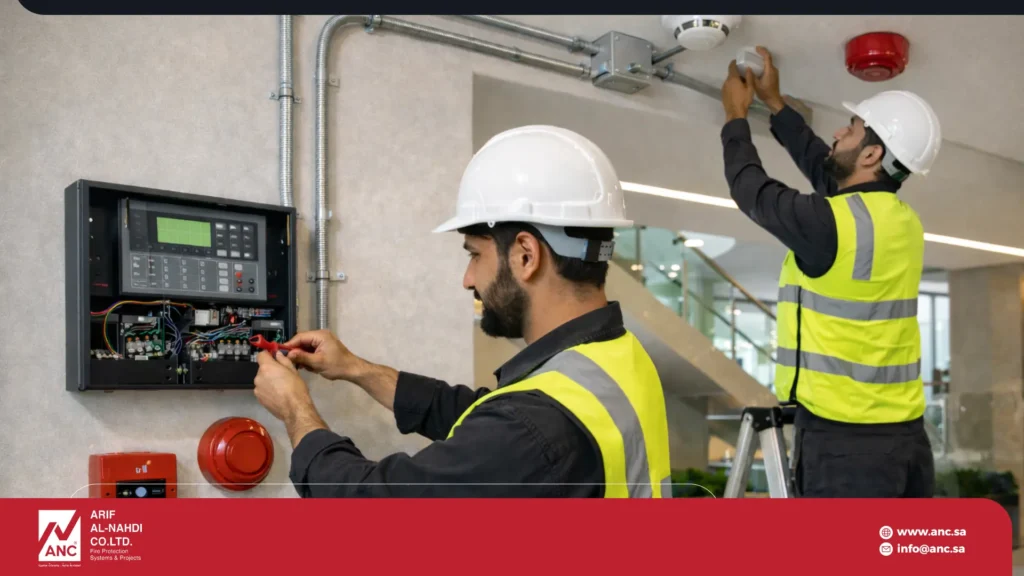
A typical fire alarm system installation follows a structured sequence, even though the exact order may shift slightly between new construction and retrofit work.
In most building projects, the process is:
- Site survey and scope review
- Design and document coordination
- Material submittals
- Pathway preparation
- Cable pulling
- Device and panel installation
- Terminations
- Programming
- Testing
- Commissioning
- User briefing
- Handover documentation
NFPA 72 covers application, installation, performance, and inspection, testing, and maintenance of fire alarm and signaling systems, which is why commissioning and documentation should not be treated as optional extras.
|
Stage |
What happens |
Who is typically involved |
Key output |
Common risk if skipped |
|
Survey and scope review |
Building use, layout, project stage, and existing conditions are reviewed |
Owner, consultant, contractor, facility representative |
Clear scope baseline |
Incorrect assumptions about system needs |
|
Design and document coordination |
Drawings, panel logic, device layout, and pathways are aligned |
Consultant, design team, contractor, supplier |
Coordinated installation intent |
Rework and design conflicts onsite |
|
Submittals and material approval |
Proposed equipment and documents are submitted for review |
Contractor, consultant, supplier |
Approved product/document package |
Delays or mismatched equipment |
|
First fix and pathway preparation |
Conduits, trays, containment, and routes are prepared |
Site team, MEP trades, contractor |
Ready cable routes |
Congestion, access issues, incomplete routing |
|
Device and panel installation |
Panels, detectors, call points, and alarms are installed |
Fire alarm team, site team |
Installed field equipment |
Incorrect placement or incomplete field readiness |
|
Cabling and terminations |
Approved circuits are pulled and terminated |
Installation team |
Connected field network |
Faults, poor labeling, testing delays |
|
Programming and configuration |
Panel logic and system behavior are configured |
Specialist technician |
Operational system logic |
Event handling issues at test stage |
|
Testing and commissioning |
Functional checks and system verification are performed |
Commissioning team, consultant, owner rep |
Verified performance and punch list closure |
Incomplete acceptance and unreliable operation |
|
Training and handover |
Records, instructions, and support path are transferred |
Contractor, facility team |
Usable handover package |
Weak post-installation operation |
The value of this sequence is that it reduces the gap between “installed” and “actually ready.” A system can look complete physically and still remain incomplete if testing, documentation, labeling, or user handover are not handled properly.
If your project is moving from planning into execution, a technical consultation can help define what should be included in the installation scope before procurement or site work begins.
ANC provides services for design and consulting, safety project implementation, maintenance contracts, and technical support. Request your service now in Saudi Arabia!
Also read: Conventional vs Addressable Fire Alarm System: A Decision Guide for Saudi Projects
Fire Alarm System Design Before Installation
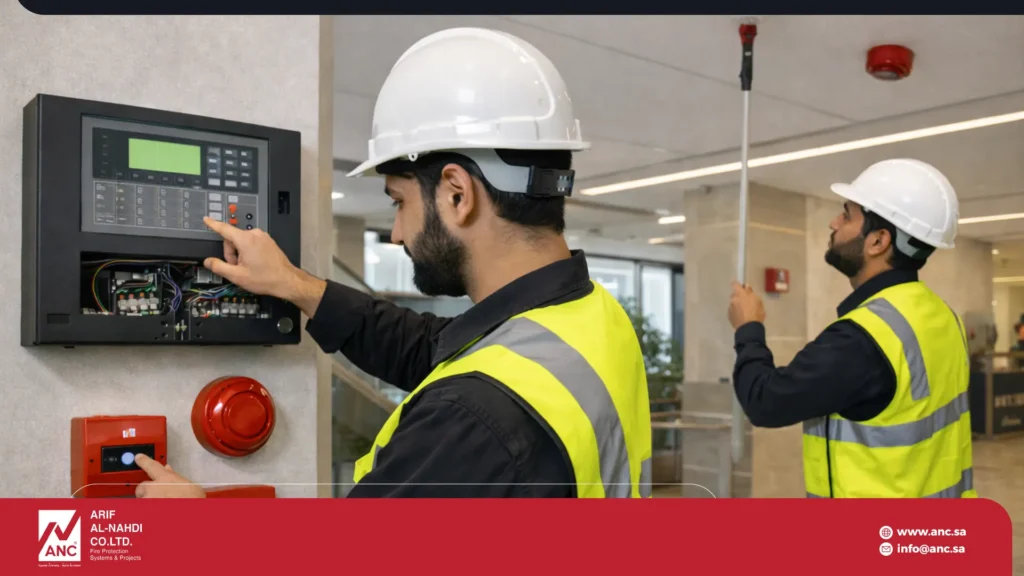
Fire alarm system design is the step that turns a safety objective into a workable installation plan. It affects the type of system selected, the device layout, the control strategy, the need for zoning or addressing, the extent of interfaces, and how the installation team will route and terminate circuits.
Without that coordination, site execution becomes reactive, and even a high-quality product can end up poorly integrated into the building.
At project level, the documents that matter are usually not just a single fire alarm system installation pdf, but a coordinated package: layouts, riser concepts, device schedules, panel-related logic, and wiring-related drawings that show how the system is meant to be installed and tested. In many projects, teams also refer to a fire alarm system design pdf as part of the document set used for review, approval, and installation planning.
In practice, those documents help prevent site improvisation and clarify what the contractor is pricing, what the consultant is reviewing, and what the commissioning team is expected to verify. A complete fire alarm system design package makes it easier to align field installation with project intent and reduces errors during testing and handover.
This is also where we see the difference between conventional and addressable design more clearly. In our conventional fire alarm systems, the design typically follows zone-based logic that suits small to mid-size buildings.
In our ML-122X addressable panel solution, the system supports device-level identification, flexible programming, and Cause & Effect scenarios for more advanced projects.
This distinction affects not only how the system operates, but also how the installation is documented, tested, and expanded over time.
For projects that are still defining the right fire alarm system design path, we provide consultation and technical support to help coordinate requirements early, before site execution begins.
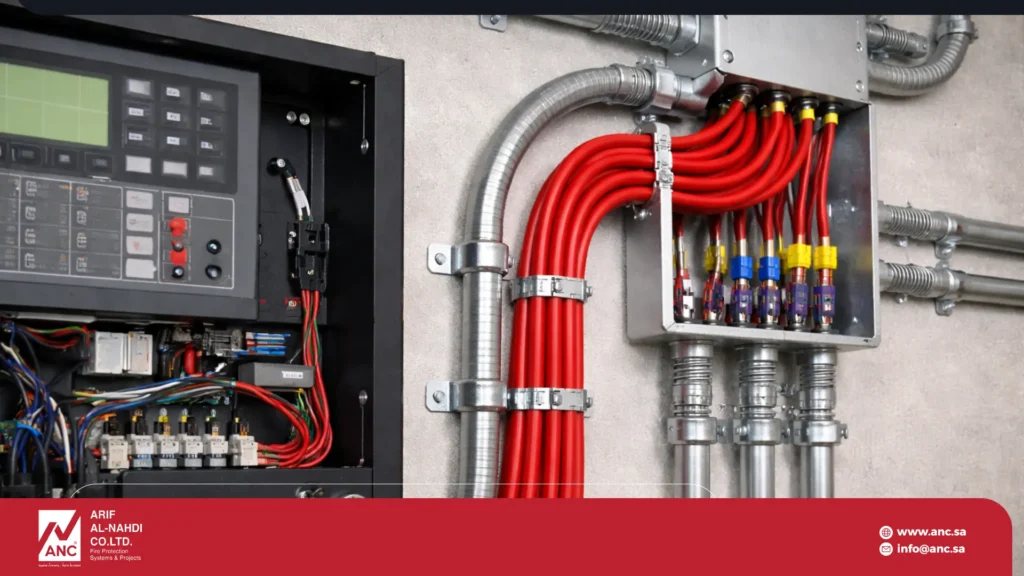
Cable Types and Wiring Considerations for Fire Alarm Systems
When people ask about the right cable for fire alarm system work, the practical answer is that cable selection depends on the system design, the circuit or pathway role, the installation environment, and the approved project documents.
cable for fire alarm system is not something that should be guessed onsite based only on a generic wiring habit. NFPA 72 positions installation and performance as part of a broader code framework, which is why wiring decisions should follow coordinated design documentation rather than informal field assumptions.
cable for fire alarm system selection should match the system function, pathway conditions, protection method, labeling, and future maintenance access. The fire alarm system wiring diagram should be part of the approved project documents, not decided after installation starts.
Good fire alarm system wiring diagram also improves what happens after handover. Clear routing, proper identification, clean terminations, and alignment with approved drawings make fault tracing, servicing, and future changes much easier.
If the project still needs clarity on system type, pathways, or installation scope, ANC provides fire alarm solutions and technical support to support a more structured review.
NFPA and Code Reference Points to Consider
When referring to NFPA requirements for fire alarm installation, it is more accurate to treat them as technical reference points, not a substitute for project documents or authority procedures. NFPA 72 provides the framework for fire alarm and signaling systems, including installation, performance, and inspection, testing, and maintenance.
In practice, however, installation decisions should not rely on broad claims such as “NFPA compliant” alone. They should be based on approved drawings, selected products, building conditions, and the project’s actual scope.
The same applies in Saudi Arabia, where local project requirements, consultant comments, handover expectations, and authority processes can all affect execution. NFPA helps define the framework, while approved project documents determine how that framework is applied in practice.
How Long Does Fire Alarm Installation Take in a Commercial Building?
There is no fixed timeline for fire alarm system installation in a commercial building. The duration depends on factors such as building size, number of devices, new-build or retrofit conditions, site readiness, pathway availability, coordination with other trades, and the scope of testing and handover.
In many cases, retrofit projects take longer than expected because access may be limited, work may need to follow occupancy schedules, and existing site conditions may differ from the original assumptions. New construction can move more smoothly when pathways and coordination are planned early, but progress still depends on drawing clarity and site readiness.
A more useful question is not “What is the standard duration?” but “What information is needed to estimate the duration accurately?” That usually includes the building type, project scale, new-build or retrofit status, drawing availability, required scope, and whether testing and commissioning are included.
If a more realistic timeline is needed, sharing the project stage, available drawings, and required scope will usually lead to a more accurate technical assessment than relying on a general estimate.

How to Choose a Qualified Fire Alarm Contractor in Saudi Arabia
Choosing a qualified contractor for fire alarm system installation is not only about product supply. It is about selecting a contractor who can coordinate design intent, define the scope clearly, manage installation in an organized way, carry out testing and commissioning properly, and provide support after handover.
For building owners, consultants, and project teams, practical evaluation criteria are more useful than relying on a general claim alone.
A suitable contractor should be able to work from coordinated drawings, explain the installation sequence clearly, support testing and handover requirements, respond to post-installation issues, and align the system with the building’s actual operational needs.
In many Saudi projects, this continuity between design, installation, commissioning, and after-sales support is what makes the real difference over time.
Checklist Before Requesting a Fire Alarm Installation Quote
- Building type and city
- New build, fit-out, retrofit, or replacement
- Availability of drawings or submittals
- Required scope: design support, installation only, or installation with testing and commissioning
- Whether there is an existing fire alarm system onsite
- Any timeline constraints or phased occupancy requirements
- Whether post-handover support or maintenance is required
For projects that require a structured approach from consultation to execution, ANC provides fire alarm solutions, technical support, project implementation, and follow-up services in Saudi Arabia.
If you are evaluating a contractor for a new installation, retrofit, or system upgrade, ANC offers a practical path built on clear scope definition, coordinated execution, and ongoing support. Get your consultation now!
Also check: Fire Protection System: Complete Guide to Active & Passive Protection
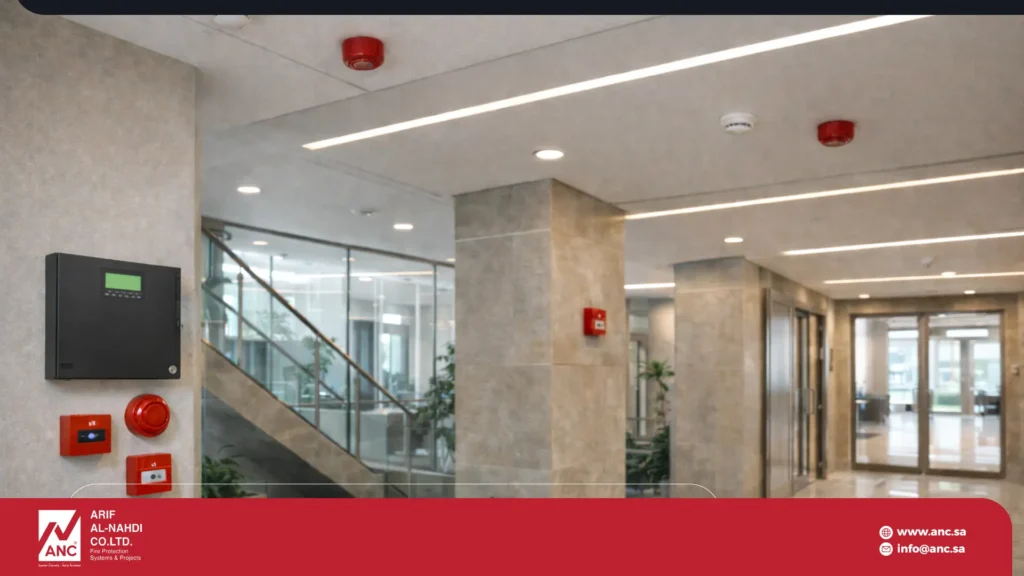
Fire Alarm System Installation by ANC in Saudi Arabia with End-to-End Project Support
When you are planning a fire alarm system installation in Saudi Arabia, the value of the project does not depend on equipment alone.
It depends on how well the system is designed, coordinated, installed, tested, and supported after handover.
That is where we focus our role: helping clients move from project requirements to a practical, well-structured building fire alarm system solution that supports safety, operability, and long-term reliability.
1- Our Fire Alarm Installation and Project Services
We support clients through the full workflow of fire alarm system installation, from early consultation and fire alarm system design review to project execution, testing, commissioning, and follow-up support.
Whether the requirement is a new installation, retrofit, replacement, or system expansion, we help align the scope with the building type, project stage, and operating needs.
Our support also extends to reviewing installation documents, coordinated layouts, and project files such as a fire alarm system installation pdf or fire alarm system design pdf when available.
2- Fire Alarm Design, Wiring, and Technical Coordination
A reliable installation starts with clear technical coordination. We help clients review key design requirements, pathway planning, panel logic, and documentation before site execution begins.
This includes practical guidance around fire alarm system design, approved layouts, and the role of the fire alarm system wiring diagram in supporting organized installation, testing, and future maintenance.
Where cable planning is part of the scope, the selection of the right cable for fire alarm system applications should always follow project requirements, approved documents, and the installation environment.
3- Fire Alarm Products and System Options Available
We provide fire alarm solutions that support different building needs, including building fire alarm system applications for commercial, residential, industrial, and mixed-use projects.
Our offering includes conventional fire alarm systems for projects that rely on zone-based logic, as well as addressable fire alarm solutions for projects that require device-level identification, flexible programming, and clearer event management.
This allows clients to evaluate the right system architecture based on project scale, design intent, and long-term operational requirements.
Our products:
1- Intelligent Addressable Gas Detection and Alarm System – BR.022
2- Maxlogic Intelligent Addressable Smoke Damper Control Module – MM.BRS.YD.001
3- Maxlogic ML-122X Intelligent Addressable Fire Alarm Control Panel – MM.BRS.YD.007
4- Maxlogic Intelligent Addressable Aspirating Smoke Detector – MM.BRS.YD.052
5- Conventional Gas Detection & Alarm System – MM.BRS.YD.061
6- Conventional Fire Extinguishing Control Panel – MM.BRS.YD.004
7- Conventional Fire Detection and Alarm Systems – MM.BRS.YD.058
8- Approved Marine Type Fire Detection and Alarm Systems – MM.BRS.YD.037
9- Intelligent Smoke Damper Control Modules – MM.KTL.YD.005
10- Industrial Gas Detection & Alarm System – MM.BRS.YD.064
11- Maxlogic SPRVSR+ System- Graphical Monitoring System – MM.BRS.YD.031
Why Do Clients in Saudi Arabia Choose to Work with Us?
Clients often need more than product supply. They need a team that can support the project from consultation to execution, while keeping installation, documentation, testing, and post-handover support connected within one practical workflow.
That is why we approach fire alarm system installation as a complete project path rather than an isolated site activity.
If you are planning a new system, reviewing an upgrade, or preparing documents for quotation, we can help you assess the scope, review the project requirements, and move toward a more structured installation plan. Contact ANC now!
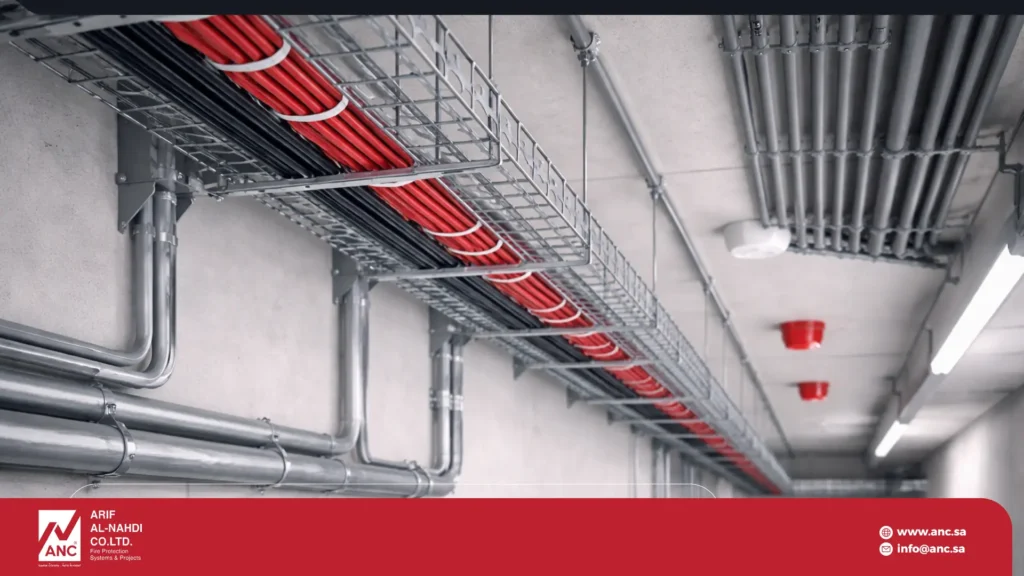
Testing, Commissioning, Handover, and What Happens After Fire Alarm System Installation?
A fire alarm system is not considered complete simply because the panels and devices have been installed.
In our view, the installation becomes fully operational only after the system has been tested, commissioned, documented properly, explained to the facility team, and placed under a clear support and maintenance plan.
Why This Stage Matters
This stage has a direct impact on how confidently the system can be operated after handover. Testing and commissioning help confirm that the installed system functions as intended, while documentation and user briefing make it easier for the building team to understand the system, respond to faults, and manage future servicing requirements.
Common Issues After Installation
This is also the stage where many projects either gain long-term value or create avoidable problems. When labeling is unclear, records are incomplete, training is limited, or fault-handling responsibilities are not clearly explained, the facility team is left with uncertainty instead of a system that can be managed with confidence.
What Proper Handover Should Achieve
A proper handover should give the owner or facility team a clear understanding of what has been installed, how the system is intended to operate, what documentation is available, and what support path should be followed if faults, changes, or future expansion needs arise.
Ongoing Support After Handover
We also see this stage as the point where installation connects with long-term reliability. A fire alarm system performs better over time when testing, maintenance, and support are treated as part of the full lifecycle rather than as separate tasks after project completion.
Project Information Template for Fire Alarm Installation Inquiry
To help us provide a more accurate consultation, we recommend preparing the following information:
- Facility type
- City
- Project stage: new build, retrofit, expansion, or replacement
- Available documents, such as layouts, riser diagrams, device schedules, or other drawings
- Required scope: consultation, installation, testing and commissioning, or ongoing support
- Whether the system is conventional or addressable, if already known
- Any existing issues, phasing constraints, or owner / consultant notes
When your project reaches the stage where scope, testing, or handover needs to be discussed more clearly, we provide service request and technical support channels to help with consultation, project implementation, and follow-up across Saudi Arabia.
Conclusion
A well-planned fire alarm system installation is not a single site activity. It is a structured process that begins with design coordination, continues through pathways, cabling, and device installation, and ends only when testing, commissioning, and handover are completed properly. The quality of that process affects how clearly the system works, how manageable it is after handover, and how confidently the building team can operate and maintain it.
For some projects, the biggest challenge is clarifying the design path before installation begins. For others, it is understanding wiring implications, planning a realistic timeline, or choosing a contractor that can handle commissioning and support as well as installation. In each case, the most useful next step is usually a project-based discussion rather than a generic assumption.
If you are planning a building fire alarm system in Saudi Arabia, upgrading an existing system, or preparing an installation package for quotation, ANC offers consultation, project implementation, technical support, and service request channels that can help move the discussion from general guidance to project-specific action.
FAQs about fire alarm system installation in Saudi Arabia
1- How is a fire alarm system installed step by step?
A typical installation starts with site survey and scope review, then moves into design coordination, submittals, pathway preparation, device and panel installation, cabling and terminations, programming, testing, commissioning, and handover. The exact sequence varies by project type and building conditions.
2- What cable is used for a fire alarm system?
The right cable for fire alarm system depends on the system design, the circuit or pathway role, the installation environment, and the approved project documents. cable for fire alarm system choice should follow coordinated design and approved drawings rather than site guesswork.
3- What NFPA requirements apply to fire alarm installation?
The main reference point is NFPA 72, which NFPA describes as covering fire detection, signaling, application, installation, performance, and inspection, testing, and maintenance for fire alarm and emergency communications systems. Project execution still depends on approved drawings and local project requirements.
4- How long does fire alarm installation take in a commercial building?
There is no universal timeline. Duration depends on building size, number of devices, new-build versus retrofit conditions, pathway readiness, coordination with other trades, and the extent of testing and handover required.
5- Should I hire a licensed or qualified contractor in Saudi Arabia?
Yes. For commercial and multi-use projects, a qualified contractor helps connect fire alarm system design intent, installation workflow, testing, commissioning, documentation, and post-handover support, which reduces rework and improves manageability.
6- What documents should I prepare before requesting a fire alarm installation quote?
The most useful starting information before building fire alarm system includes the building type, city, project stage, available drawings, required scope, whether the project is new or retrofit, and whether testing, commissioning, or support are part of the requirement.