
Fire Extinguishers Required in Saudi Arabia—are you fully ready for the winter camping season, and sure you have the right units with the correct specifications? In camps and rest houses, a tiny spark from wood, charcoal, or an electrical short can turn within seconds into a fire that threatens lives and property, especially in highly flammable outdoor setups.
The problem is that many people buy just any extinguisher or place it in an unsuitable spot, then realize too late that their setup does not meet the safety requirements for camps.
In this guide, you will learn exactly which fire extinguishers are required for winter camps and rest houses, including the types, the needed quantity, and where to place them—so you can start the season with peace of mind.
Camps and Rest Houses as High-Risk, Highly Flammable Environments
Winter camps and rest houses are not just places to sit; they are open, fast-igniting environments, and one small mistake can turn into a fire within minutes. That is why they are among the locations most in need of core safety readiness—starting with approved fire extinguishers—so pay close attention to:
Plenty of combustible materials (tent fabrics, carpets, wood).
Heat and open-flame sources near seating areas (wood, charcoal, heaters).
Temporary electrical extensions and generators that increase short-circuit risk.
Wind and open spaces that can spread fire quickly.
Saudi Civil Defense Requirements for Camps and Rest Houses
Saudi Civil Defense requirements for camps and rest houses are presented as clear points aimed at ensuring the site is ready before and during the season—most importantly, the fire extinguishers required in Saudi Arabia by law.
Saudi Civil Defense fire extinguisher requirements are typically grouped into readiness, inspection, and legal compliance, as follows:
Readiness: Mandatory provision of approved fire extinguishers suitable for the nature of the camp or rest house.
Inspection: Seasonal inspection rounds to confirm readiness before and during the season.
Compliance: Fines and penalties for non-compliance or missing safety requirements.
Approval: Verification of extinguisher validity, clear labeling, and rapid accessibility.
Read also: How Do Low Winter Temperatures Affect Fire Pumps?
What Types of Fire Extinguishers Are Legally Required?
The types of fire extinguishers required in Saudi Arabia by law are determined by the most common ignition sources on site, because fires in camps and rest houses do not follow a single pattern. The right choice is not based on price or size alone, but on the expected fire class and how quickly it can be controlled. Key legally required fire extinguisher types include:
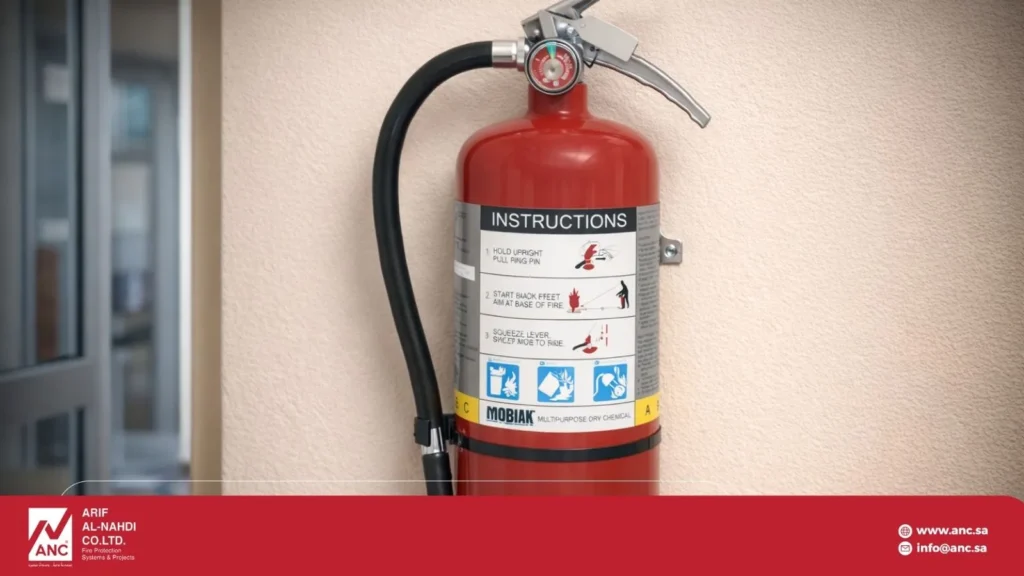
ABC Dry Powder Fire Extinguishers
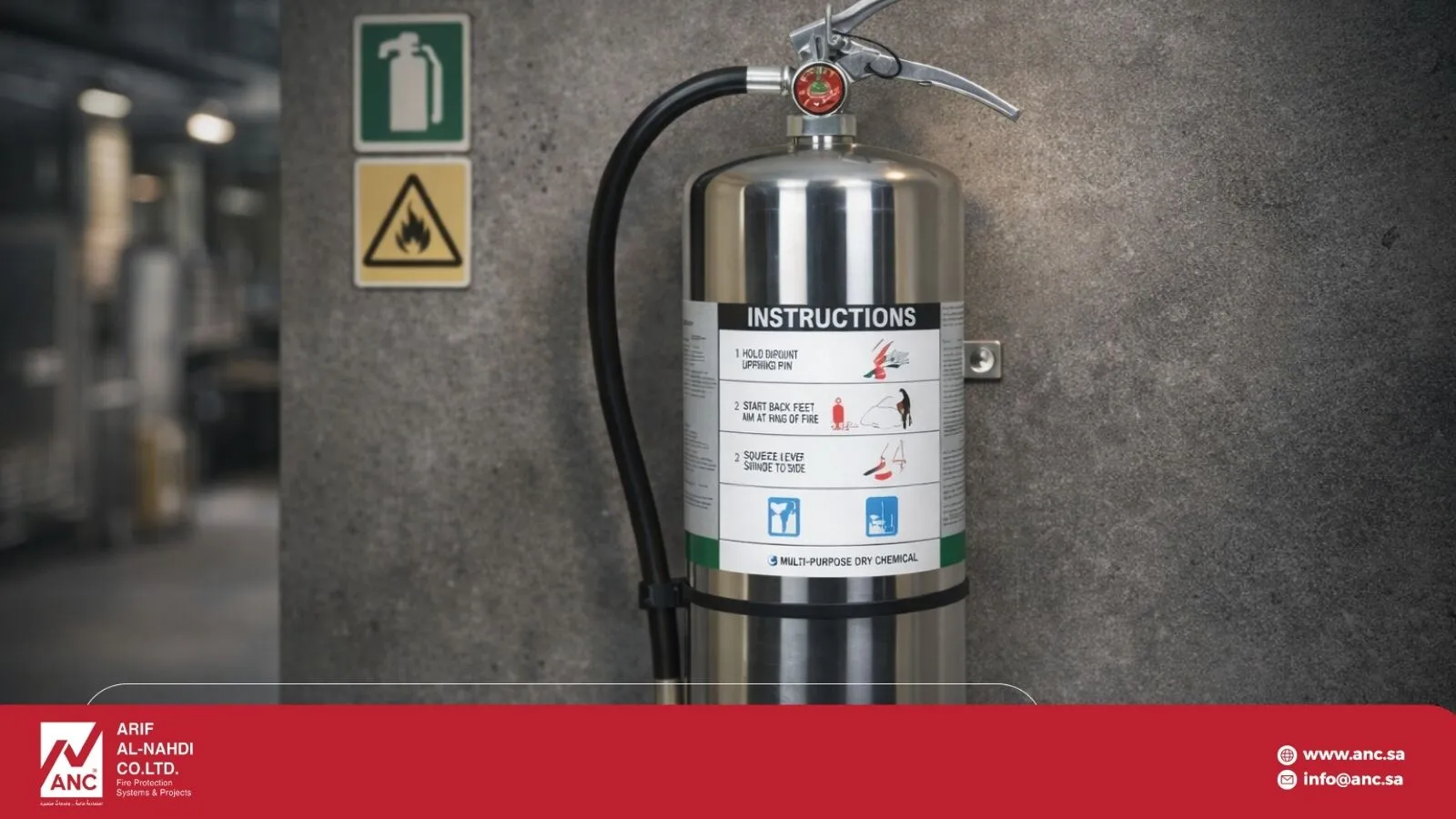
ABC extinguishers are the most common choice for camps and rest houses because they are suitable for multiple fire classes—especially combustible solids such as wood and fabrics. They are also effective for flammable liquid fires and can be used on electrical fires caused by shorts in extensions or equipment. For that reason, they are often the foundational extinguisher in winter-season safety readiness.
Carbon Dioxide (CO₂) Fire Extinguishers
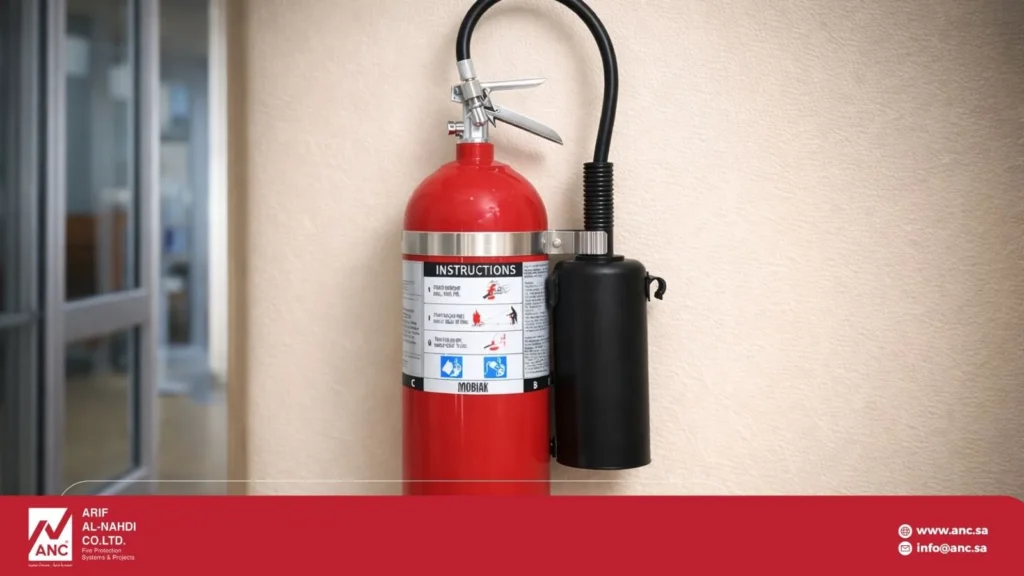
CO₂ extinguishers are commonly used when the main risk is electrical—such as areas with generators, distribution boards, or many devices operating in a tight space. They leave no powder residue that could damage equipment, making them ideal near electrical sources and sensitive assets. Having them in semi-enclosed areas inside rest houses or generator rooms clearly improves readiness.
Foam Fire Extinguishers
Foam extinguishers are an important option when liquid fuels or flammable oils are present, such as outdoor cooking areas or fuel storage points in some rest houses. Foam works by separating the burning liquid from oxygen and cooling the fire surface, which helps prevent re-ignition. That is why it is recommended for rest houses with outdoor kitchens or frequent use of oils and fuels.
If you want a correct setup from the first time, contact Arif Al-Nahdi Co. Ltd (ANC) to supply SASO-compliant, approved fire extinguishers and determine the right type and quantity for your camp or rest house before the season starts.
Read also: Fire Doors in the Rainy Season: Why Check Seals and Insulation?
Required Number of Fire Extinguishers by Camp or Rest House Size
The required number of fire extinguishers changes based on the size of the camp or rest house and how it is used, because the goal is to keep an extinguisher nearby and easy to reach during any emergency. Based on site scale and the distribution of higher-risk points, the breakdown is typically:
Small areas: Basic extinguishers in a suitable quantity to cover the full area.
Large camps: Increased quantity with the site divided into clearly defined coverage zones.
Correct distribution: Place extinguishers along movement paths with distances that ensure quick access.
Higher-risk zones: Add extra extinguishers near cooking, charcoal, generators, and electrical extensions.
Where to Install Fire Extinguishers in Winter Camps
Fast response in a camp fire can come down to seconds—and extinguisher placement is the deciding factor, because a hidden or distant unit can become useless in an emergency. For that reason, fire extinguishers for camps and rest houses should be distributed to clearly cover ignition points and exit routes:
Near ignition sources (wood, charcoal, heaters, generators).
At camp entrances and exits to ensure quick access during evacuation.
In cooking and seating areas because they are most exposed to sparks and spills.
Along main movement paths inside the camp, in a visible and easy-to-reach location.
Read also: Winter Fire Risks: How to Protect Your Home from Heater Fires
Specifications for Approved Fire Extinguishers in Saudi Arabia
Fire extinguishers in camps and rest houses are only accepted when they are approved and meet Saudi requirements, because a non-compliant extinguisher is not considered a legally valid safety provision and may not perform effectively in an emergency.
So make sure approved fire extinguishers in Saudi Arabia meet the following:
Compliant with SASO standards.
Valid, in-date, with a clear inspection date.
Clear operating instructions in Arabic.
Complete nameplate data (type, capacity, rating, batch/model number).
Read also: Winter Electrical Loads in Winter: When Does a Heater Become a Risk at Home?
Common Mistakes When Equipping Camps with Fire Extinguishers
Most safety problems in camps and rest houses start from small details that seem minor—but during a fire, they become a direct reason for failing to control it. That is why it matters to know the common mistakes in equipping camps with fire extinguishers before the winter season begins.
Using expired or uninspected extinguishers.
Placing extinguishers in non-visible locations or where they are hard to access quickly.
Relying on one type only despite different ignition sources (wood/electricity/fuel).
Buying non-approved extinguishers or units without clear Arabic labeling/data.
Do Requirements Differ Between Private and Commercial Camps?
Safety requirements—and the fire extinguishers required in Saudi Arabia by law—can differ between private and commercial camps based on the number of users, the nature of activity, and the level of legal responsibility. Sites are typically considered according to classification and operation mode, such as:
Family (private) camps.
Investment camps for rent (commercial).
Licensed rest houses operated as a hosted reception facility.
ANC’s Role in Equipping Camps and Rest Houses
Start your season with confidence with Arif Al-Nahdi Co. Ltd (ANC), because equipping a camp or rest house is not just buying an extinguisher—it is selecting approved extinguishers, distributing them correctly based on site conditions and ignition sources, and checking readiness before peak seasonal crowds.
Supplying approved fire extinguishers ready for use.
Determining the right type and quantity based on site size and risk sources.
Inspecting and approving safety readiness before the season.
Educating clients on correct use.
Contact ANC now to equip your camp or rest house with approved fire extinguishers and get a quick assessment for quantity and distribution before the winter season begins.
When Should Fire Extinguishers Be Inspected?
Inspection timing is just as important as having extinguishers on site, because a unit may look ready but fail when needed if maintenance is neglected or it is out of date. To keep camp and rest house fire extinguishers ready throughout the season, follow these key checkpoints:
Before the winter season starts.
During ongoing use.
After any emergency use.
Fire Extinguishers Required in Saudi Arabia are part of a simple decision that makes a major difference: equip an approved extinguisher in the right quantity, type, and location, instead of relying on luck at the first spark. Meeting safety requirements protects lives, reduces losses, and gives you a calm, secure season for your family and guests.
Contact Arif Al-Nahdi Co. Ltd (ANC) to equip your camp or rest house with approved fire extinguishers and verify readiness before the winter season—reach out to ANC today.
FAQs About Required Fire Extinguishers for Winter Camps and Rest Houses
1- Is one extinguisher enough for a camp?
Usually not; the number depends on camp size, seating distribution, and ignition sources. It is best to provide more than one extinguisher and distribute them across higher-risk points.
2- Do requirements differ between charcoal and heaters?
Yes; charcoal and wood fires are typically solid-combustible fires suited to an ABC dry powder extinguisher, while electric heaters may also require a CO₂ extinguisher near electrical sources.
3- Are home extinguishers approved for camps?
Not necessarily; what matters is that the extinguisher is approved in Saudi Arabia, SASO-compliant, in-date, and clearly labeled in Arabic.
4- Does ANC provide full camp readiness support?
Yes; ANC supplies approved extinguishers, determines the right type and quantity, helps verify readiness, and guides you on correct use.