If you are planning a new facility, upgrading an existing building, or reviewing a fire protection system, understanding the fire pump system is essential. This system is not just a piece of equipment in a pump room. It is a critical part of the wider fire protection setup that helps maintain the water flow and pressure needed during an emergency.
In many projects, the incoming water supply alone is not enough to support sprinklers or fire fighting lines at the required performance level. That is where a fire pump system becomes important. It helps bridge the gap between available supply and actual fire protection demand.
For you as an owner, consultant, contractor, or procurement lead, the decision is not simply whether you need a pump. The more important question is which arrangement fits your project requirements, water source, power conditions, approved design, and long-term maintenance expectations.
This article is designed to help you understand the system in practical terms. You will find a simple breakdown of the main components, how to read a fire pump diagram, what matters in the pump room, how installation usually works, and what information to prepare before requesting a quote or consultation.
Safety notice / disclosure: This content is for awareness and decision support only. Final requirements vary by facility type, water source, approved design, owner or consultant requirements, and authority expectations. Installation, testing, and maintenance should follow applicable project standards and local requirements through qualified professionals.
What Is a Fire Pump System?
A fire pump system is part of a building’s fire protection setup. Its role is to provide the water flow and pressure needed for sprinklers or related firefighting lines when the normal water supply is not sufficient.
In practical terms, this matters when your facility cannot rely on incoming pressure alone and needs a dedicated system to support fire protection performance during an emergency.
NFPA 20 is the main reference for the selection and installation of stationary fire pumps. NFPA 25 is the baseline reference for inspection, testing, and maintenance after installation.
A fire water pump system is also not a complete fire safety solution by itself. It works as one part of a wider arrangement that may include:
- water storage
- piping
- valves
- controls
- alarms
- the protected fire network
So if you are evaluating your next step, the real question is not just:
- Do I need a pump?
It is also:
- What system arrangement fits my approved design?
- What is my available water source?
- What are my power conditions?
- What does the facility actually require?
That decision path is far more useful than generic product selection.
Request now a technical consultation from ANC for your fire pump system project!
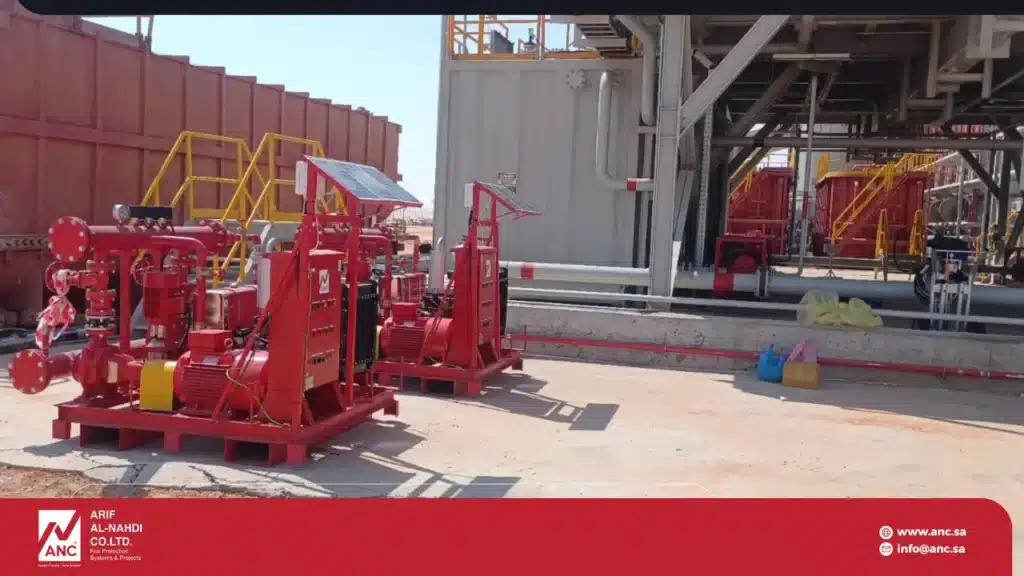
Main Fire Pump System Components
When you search for fire pump system components, you usually want a clear answer: what is inside the system, and what does each part do?
A typical system may include:
- the fire pump
- the driver
- the controller
- the jockey pump
- suction and discharge piping
- valves and gauges
- the water supply interface
The final arrangement always depends on project requirements and approved design documents.
Component | Function | Where it appears in the diagram | What to verify during installation |
Fire pump | Builds the pressure and flow needed for the fire protection network | Main equipment block between water source and discharge side | Alignment with approved design, access, connections, service space |
Driver | Powers the main pump, commonly electric or diesel | Attached to or paired with the main pump | Power or fuel readiness, environmental suitability, integration |
Controller | Starts, monitors, and manages pump operation | Near the pump/driver arrangement | Correct coordination with the selected driver and project documents |
Jockey pump | Maintains system pressure and reduces unnecessary main pump starts | Smaller auxiliary pump near the main set | Proper role in pressure maintenance and control integration |
Suction piping | Brings water from the source to the pump | Upstream side of the pump | Water source coordination, routing, valve arrangement |
Discharge piping | Carries pressurized water into the fire protection network | Downstream side of the pump | Network connection, valve positioning, access for testing and maintenance |
Valves and gauges | Isolate, monitor, and support system control and verification | On suction/discharge lines and key monitoring points | Accessibility, readability, placement per approved documents |
Water supply interface | Connects the system to tank, reservoir, or source line | At the beginning of the flow path | Actual source conditions, continuity, and project coordination |
How These Components Work Together?
The main pump is the heart of the system, but it does not operate in isolation.
The driver determines how the pump is powered. In many projects:
- an electric driver may suit facilities with dependable electrical infrastructure
- a diesel driver may be considered where power continuity planning points in that direction
The important point is not that one is always better. The right choice depends on project conditions and approved requirements.
The controller matters because the fire pump system is not just mechanical equipment. It is also a controlled emergency-response asset. The jockey pump supports normal pressure maintenance and helps reduce unnecessary starts of the main fire pump when small pressure drops occur.
During an emergency, the system works as a connected chain:
- Water comes from the source.
- The pump and driver build the required pressure.
- The controller governs system response.
- The discharge side feeds the wider fire protection network.
That is why choosing a pump based on assumption alone is risky. The real decision is about system fit, not isolated hardware.
Need help defining the right system path? Contact our team for technical guidance.
Read more: How Fire Pumps Work: A Comprehensive Detailed Guide
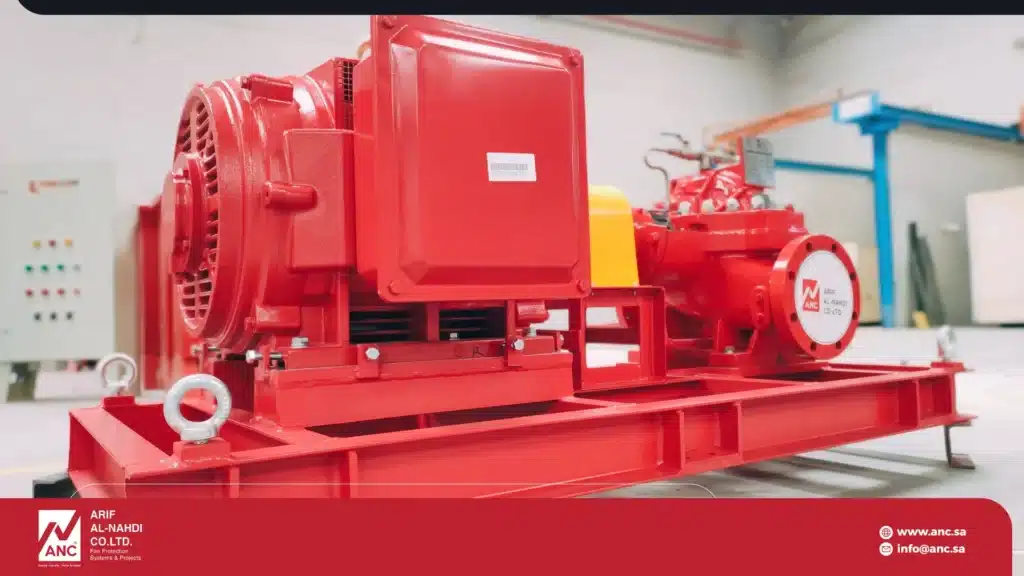
How to Read a Fire Pump System Diagram?
A fire pump system diagram becomes much easier to understand when you stop reading it like a drafting sheet and start reading it like a flow path.
Start with the main sequence:
- Identify the water source.
- Find the main pump.
- Locate the driver and controller.
- Follow the discharge path toward the fire protection network.
- Locate the jockey pump, valves, gauges, and monitoring points.
A useful way to read the diagram is to ask these questions:
- Where does water enter?
- Where is pressure created?
- How is the response controlled?
- Where does water go after the pump?
- Which points will matter later for testing, access, and maintenance?
This approach helps you understand more than symbols. It also helps you evaluate planning issues such as:
- whether the system depends on a tank or another source
- whether the room needs electrical or fuel coordination
- whether equipment access is realistic
- whether future maintenance has been considered early
As a buyer or decision-maker, you should expect the diagram to answer planning questions, not just look technical. For example:
- Does it suggest a practical room layout?
- Does it show a clear service path?
- Does it highlight coordination needs with power, fuel, drainage, controls, or the wider network?
A drawing may look complete but still fail to support good procurement or installation decisions. Get a tailored fire pump system recommendation for your facility by ANC!
Also Read: Fire Pump Buying Guide in Riyadh: Arif Al-Nahdi (ANC) – The Best Fire Pump Company
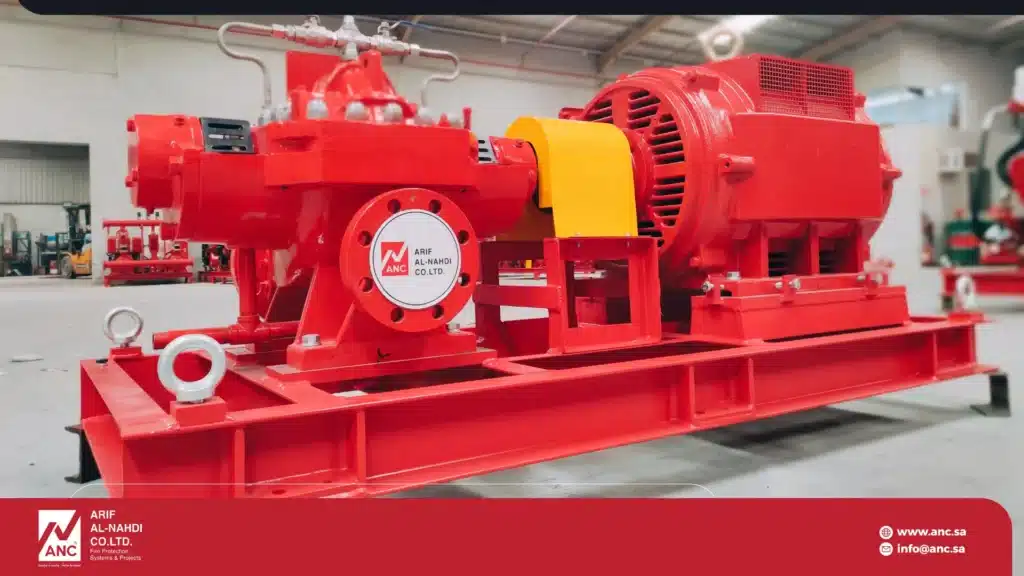
Fire Pump Room Requirements and Standards
A fire pump room is not just a place to store equipment. It directly affects:
- access
- protection
- operation
- serviceability
- future maintenance
In real projects, weak room planning often creates avoidable problems later, such as:
- restricted maintenance access
- poor coordination with incoming services
- difficult commissioning
- handover complications
At a high level, the pump room should be reviewed in terms of:
- access and working space
- environmental suitability
- power or fuel coordination, where applicable
- alignment with the approved project design
The exact design path should never be improvised from generic online advice. Room requirements depend on the project documents, code path, and authority expectations.
Standards Context
From a standards perspective:
- NFPA 20 is the main reference for selecting and installing stationary pumps for fire protection
- NFPA 25 is the baseline reference for inspection, testing, and maintenance of water-based fire protection systems after installation
For you, the practical takeaway is simple:
- NFPA 20 helps frame how the fire pump installation should be selected and installed
- NFPA 25 helps frame what happens after installation to keep the system ready
- final project requirements may still depend on owner specifications, approved design, and local authority expectations
Read more: Standard Fire Pumps vs. UL/FM-Approved Fire Pumps: Which One Is Best for Your Needs?
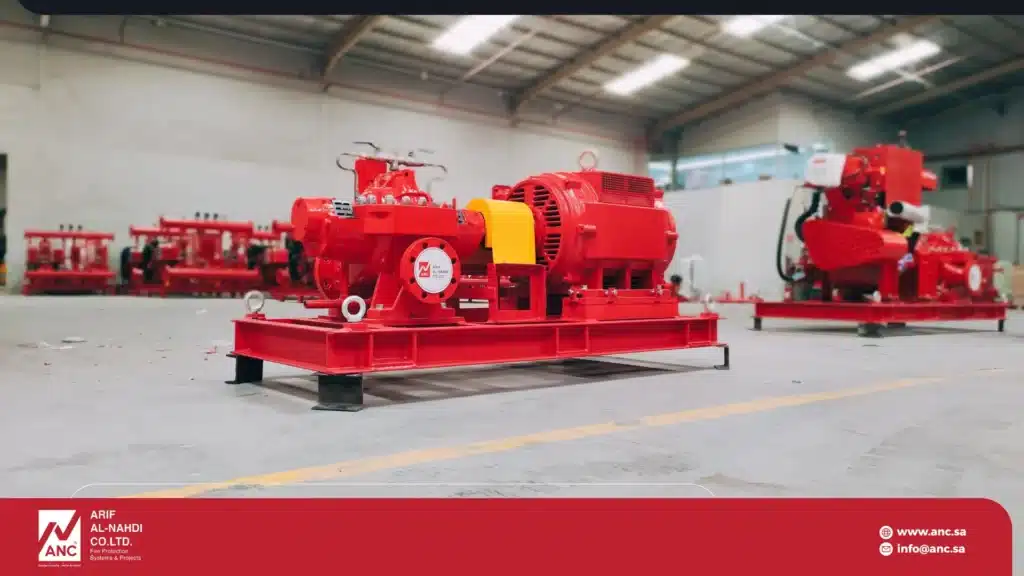
How a Fire Pump System Is Installed?
When people ask how a fire pump system is installed, the most useful answer is to explain the sequence clearly without turning it into a field manual.
Installation is not just equipment placement. It is the execution of approved design intent through coordinated project steps.
Typical Installation Journey
- Requirements review: The project team reviews the facility type, applicable design documents, water source, power source, and required scope.
- Approved design coordination: Equipment selection, interfaces, and room expectations are aligned with the approved project path.
- Equipment selection: The fire water pump system configuration is chosen according to the required arrangement, not guesswork.
- Site readiness: The room, utility interfaces, access routes, and supporting conditions are reviewed before delivery and installation.
- Delivery and installation: Equipment is positioned and connected according to the coordinated project package.
- Controller and power integration: The control side and selected power arrangement are coordinated as part of the full system.
- Testing and commissioning: Performance verification and commissioning are completed before handover. NFPA 20 also references acceptance testing, operation, and fire pump readiness in the installation context.
- Handover and lifecycle readiness: Documentation, maintenance expectations, and service pathways should be clear from the beginning.
Common Installation Gaps
Some of the most common mistakes include:
- selecting equipment based on assumptions instead of approved design
- underestimating room readiness
- overlooking maintenance access
- failing to coordinate the pump system with the wider fire protection network
- assuming a diagram alone is enough for procurement
In reality, the right decision also depends on:
- actual water source conditions
- power availability
- project scope
- system coordination
Also Read: Common Fire Pump Problems: Causes of Sudden Fire Pump Failure and Effective Solutions
How We Support Your Fire Pump System Project at ANC?
A fire pump system project usually passes through several stages before it becomes a reliable and maintainable asset. At ANC, we support that journey by helping you move from requirement clarity to supply, project execution, and long-term operation and maintenance in Saudi Arabia.
Our role is not limited to product access. We work to connect project requirements with practical next steps, so your path is clearer from the beginning.
Who We Are and How We Work?
We are a Saudi company focused on safety and fire prevention systems. According to our company profile, we were founded in 2013 and operate a fire pump factory in Riyadh.
We approach projects by helping you clarify:
- what your facility actually needs
- what the approved design requires
- what scope is needed for supply, execution, and follow-up support
Fire Pump Systems Supplying
We help align fire pump system supply with project requirements and approved design instead of treating supply as a simple product shipment.
Our website also states that we have a fleet of trucks delivering fire pumps to clients across cities in Saudi Arabia. This matters when project readiness depends on:
- coordination
- timing
- scope clarity
- the right system path
If you already know your facility type, city, and required scope, we can help you move from broad research to a more useful technical review.
Installation and Project Execution
We support installation and project execution by aligning the equipment path with:
- approved design
- room readiness
- project interfaces
- execution requirements
Not every project follows the same sequence. A replacement scope may require a different approach from a new-build project.
What remains constant is that execution quality affects:
- access
- reliability
- long-term serviceability
If you are planning a new project or replacing an existing system, sharing the scope early helps avoid delays caused by assumptions.
Handling Operation and Maintenance
We do not treat maintenance as an afterthought.
Our public site states that we provide fire pump operation and maintenance services through a qualified team of engineers and technicians. That is important because long-term system readiness depends on more than successful installation. It also depends on:
- inspection
- testing
- preventive maintenance
- timely follow-up
This aligns with the wider NFPA 25 lifecycle approach, where reliability depends on proper maintenance after installation.
We Help You Move from Inquiry to a Qualified Request
We prefer qualified project information over vague quote requests because it leads to a more accurate next step.
When you contact us, the most useful details usually include:
- facility type
- city
- whether the project is new or a replacement
- available power source
- water source or tank context
- required scope
- owner or consultant requirements already in place
Our service request path already supports fire pump installation, maintenance contracts, and technical consultations. That allows the process to begin with practical project information instead of broad assumptions.
Ready to move from research to execution? Send us your project details.
Fire Pumps Available from Arif Al-Nahdi (ANC)
Arif Al-Nahdi (ANC) offers a range of fire pump solutions in Saudi Arabia designed to support real project requirements. Rather than treating the pump as a standalone item, we present it as part of an integrated fire protection system that can be supplied to match site conditions, project scope, and supervising authority requirements.
1) E.D.J Fire Pump Model (Electric + Diesel + Jockey) – SASO Approved
The E.D.J fire pump model is a comprehensive option for projects that require primary electric operation with diesel standby support to maintain continuity during power outages, along with a jockey pump to keep network pressure stable and the system ready for operation.
It is available with flow capacities starting from 50 GPM up to 2000 GPM and a pressure range of 8–15 bar. It is supplied as an integrated set that may include a control panel, diesel tank, battery, and other related components, making it suitable for industrial and commercial projects in Saudi Arabia.
- Configuration: Primary electric + standby diesel + jockey pump for stable network pressure.
- Use concept: Suitable when continuity of operation is a high-priority project requirement.
2) E.J Fire Pump Model (Electric + Jockey) – SASO Approved
The E.J fire pump model is designed for projects that rely on an electric motor for primary operation, supported by a jockey pump to maintain pressure and system readiness. Its compact arrangement can also support easier installation and ongoing maintenance.
This model is available with flow capacities approximately from 50 to 2000 GPM and an operating pressure range of 8 to 15 bar. It is SASO approved to support project requirements within Saudi Arabia.
- Configuration: Electric + jockey pump to maintain stable network pressure and reduce unnecessary starts.
- When preferred: Suitable when an electric-driven arrangement matches the project nature and operating requirements.
3) D.J Fire Pump Model (Diesel + Jockey) – SASO Approved
The D.J fire pump model combines a diesel engine with a jockey pump to maintain network pressure and support a fast response during emergencies. It is SASO approved and positioned for facilities that require dependable pumping performance based on a non-electric primary power source.
It is available in flow ranges starting from 50 GPM up to 2000 GPM, with pressure up to approximately 8–15 bar. This makes it relevant for sites that require robust fire pump performance in demanding operating conditions.
- Configuration: Primary diesel + jockey pump to maintain network readiness.
- Use concept: A suitable option for sites that require high reliability on a non-electric power source within project requirements.
4) Split Case Fire Pump – UL Approved
The Split Case fire pump from ANC is intended for higher-flow applications in factories, warehouses, and commercial facilities. It features an axially split volute casing that can support easier maintenance access and stronger long-term operational stability.
It is available with flow capacities from 50 to 2000 GPM and pressure from 8 to 15 bar. The design includes a double-suction impeller for better hydraulic stability and reduced vibration, along with sealing options such as mechanical seal or packing. It can also be supplied with an electric or diesel driver depending on project requirements.
- Technical advantage: A design that supports easier maintenance and reliable operation in larger applications.
- Flexibility: Can be supplied with either an electric or diesel driver based on project needs.
- Suitable for: Facilities that require higher flow rates and stronger operational continuity.
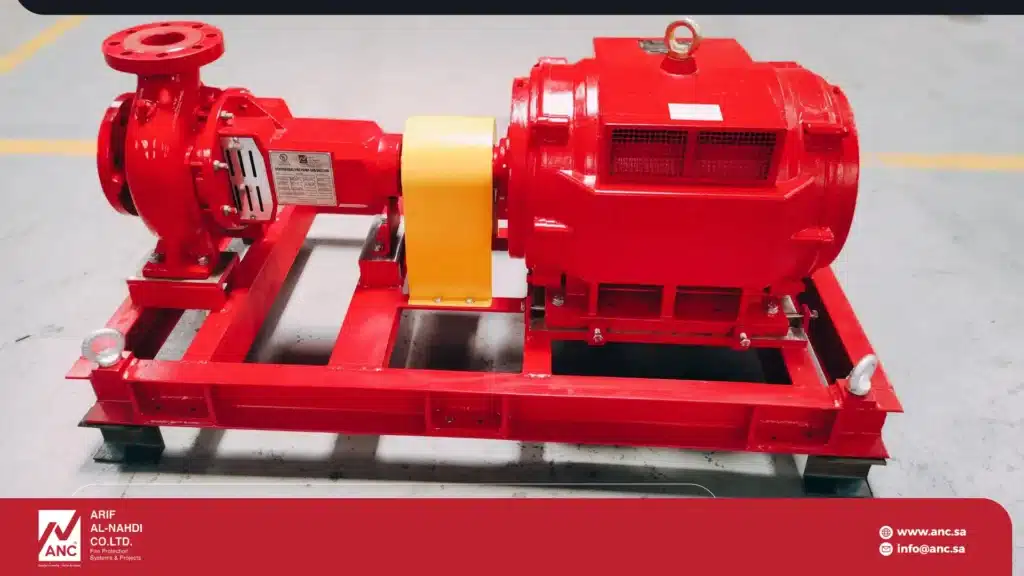
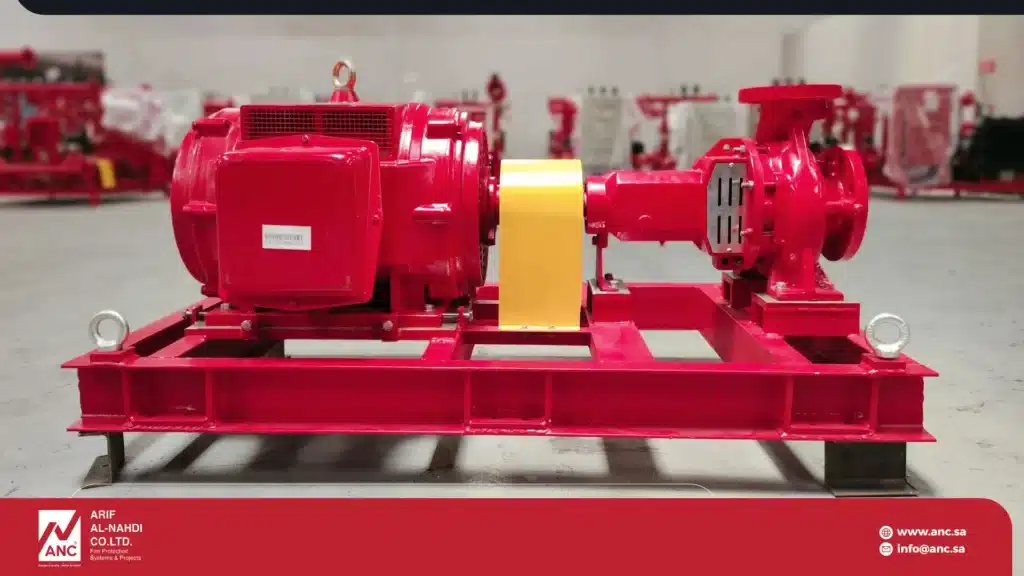
5) End Suction Fire Pump – UL Approved
ANC also offers the UL-approved End Suction fire pump as a practical and flexible option for fire protection projects. It is often considered when the project requires a balance between efficiency, installation practicality, and configuration flexibility.
This model is available in both electric and diesel configurations to suit different site needs, and it is manufactured in accordance with UL and NFPA standards to support stable and reliable performance.
- Concept: A practical solution when ease of installation and flexibility of configuration are both important within the project design limits.
- Driver options: Electric or diesel depending on site requirements.
Important note: The values stated on the product pages are indicative product ranges only. They should not be treated as general recommendations for selection or operating settings. Final model selection and system configuration should always be determined through an approved engineering design or technical review based on your project requirements, supervising authority requirements, and actual site conditions.
For a broader comparison of fire pump types and selection considerations, read: Fire Pump Types: A Complete Guide to Choosing the Right Fire Pump in Saudi Arabia.
Contact us now!Common Mistakes to Avoid When Choosing or Installing a Fire Pump System
One of the most common mistakes is choosing a fire pump system based on assumption instead of approved design.
Other frequent issues include:
- focusing only on the pump while ignoring actual water source conditions
- underestimating room readiness
- overlooking maintenance access
- assuming a clean diagram automatically provides a complete procurement basis
A diagram without context does not tell you enough about:
- execution risk
- lifecycle serviceability
- handover quality
Likewise, a product page does not replace project coordination.
In practice, reliability depends on:
- the approved design path
- installation quality
- actual operating conditions
- maintenance discipline over time
If you want to avoid weak-fit inquiries and move faster toward a useful discussion, it is better to submit actual project details than to request a generic system in isolation.
What to Prepare Before You Request a Quote or Consultation?
Before requesting a fire pump system quote or consultation, prepare the following information:
- facility type
- city in Saudi Arabia
- new project or replacement
- water source or tank details
- available power source
- required scope: supply only, installation, commissioning, or maintenance
- owner, consultant, or specification requirements already defined
This simple checklist helps make the technical review more accurate from the start and reduces delays caused by incomplete information.
What to Send When You Request a Fire Pump System Quote?
Item to send | Why it matters |
Facility type | Helps frame the likely protection context and project complexity |
City | Supports logistics, service routing, and local project coordination |
New project or replacement | Changes the installation and coordination path |
Water source details | Affects system planning and overall suitability |
Power source available | Influences driver and controller planning |
Required scope | Clarifies whether you need supply only or broader support |
Owner/consultant requirements | Keeps the review tied to the approved project path |
If you are ready to move from research to a qualified discussion, submit these details from the start. That makes the next step more practical and more accurate.
Conclusion
A fire pump system is more than a pump placed inside a room. It is a coordinated part of the fire protection setup that depends on the right components, a clear system path, suitable room planning, proper installation, and disciplined maintenance over time.
For most facilities, the real decision is not simply which pump to buy. It is which system arrangement fits your approved design, water source, power conditions, and lifecycle expectations.
If you want to move from general understanding to a qualified project review, the best next step is to prepare your project details clearly from the beginning. That gives your technical and commercial discussion a much stronger foundation.
FAQs About Fire Pump System in Saudi Arabia
1- What is a fire pump system?
A fire pump system is part of a building’s fire protection setup. It helps provide the water flow and pressure needed for sprinklers or related firefighting lines when the normal water supply is not enough.
NFPA 20 frames the selection and installation side, while NFPA 25 covers inspection, testing, and maintenance after installation.
2- What are the main components of a fire pump system?
The main components usually include:
- the fire pump
- the driver
- the controller
- the jockey pump
- valves
- gauges
- piping connections
- the water supply interface
The exact arrangement depends on your approved design and project requirements.
3- How do you read a fire pump system diagram?
Start by locating:
- the water source
- the pump
- the driver
- the controller
- the discharge path toward the fire protection network
A useful method is to follow the flow path and identify where pressure is created, controlled, and monitored.
4- Which NFPA standard applies to fire pump rooms?
For stationary fire pumps and their installation context, the main reference is NFPA 20.
For inspection, testing, and maintenance after installation, the key reference is NFPA 25.
Final project requirements may also depend on approved design and authority expectations.
5- How is a fire pump system installed?
Installation usually moves through:
- requirements review
- approved design coordination
- equipment selection
- site readiness
- installation
- testing and commissioning
- handover
The exact process varies by facility, water source, power source, and project scope.
References / Sources
1- NFPA
2- ANC Products